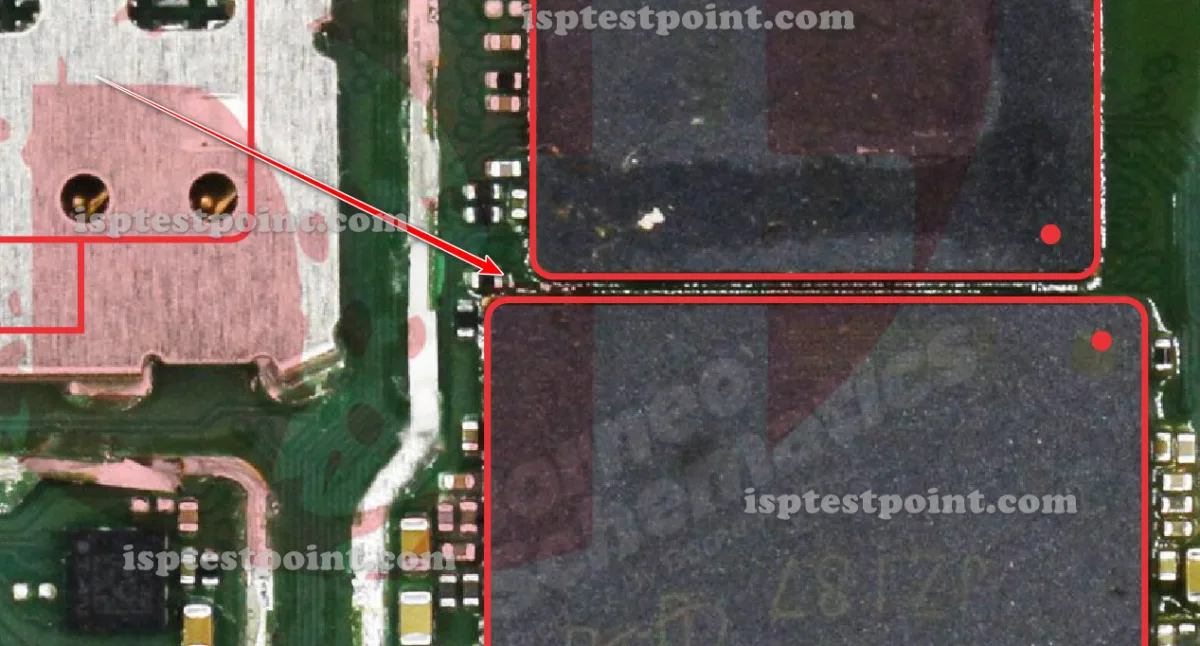
What Are Test Points
Test points are small physical access pads soldered directly to the motherboard of the Vivo Y20G. They serve as diagnostic nodes that allow technicians to measure voltage, signal integrity, and continuity without invasive disassembly. These pads connect to critical power rails, ground planes, and signal lines tied to the charging circuit, power management IC, and battery connector. Test points provide a quick reference for identifying hardware faults before proceeding with deeper repair work.

When to Use Test Points
Test points become essential when the Y20G exhibits power-related issues such as no charging response, sudden power-offs, boot loops, or complete dead-boot conditions. They allow technicians to verify voltage presence on the charging rail, confirm ground continuity, and test power delivery to the processor and memory without removing components. Testing at these pads helps isolate whether a fault lies in the charging circuit, power management IC, or downstream components. This diagnostic method saves time by narrowing the fault scope before component-level repairs.
Locating Test Points on Y20G
The primary test points on the Vivo Y20G are typically located in three key zones: near the USB charging port (bottom edge), adjacent to the battery connector (upper center area), and around the power management IC (usually near the top-left of the motherboard). Ground pads are generally distributed around the board perimeter. The charging rail test points are positioned closest to the charging port connector for easy access. Battery voltage test points sit near the battery socket. Power IC test points cluster around the power management circuitry. Exact pad locations vary slightly depending on board revision, so visual inspection under magnification is recommended to confirm positions before probing.
Safe Measurement Procedure
Begin by setting your digital multimeter to DC voltage mode (20V range minimum). Connect the black (negative) probe to a confirmed ground pad or the metal frame of the device. Place the red (positive) probe onto the target test pad using gentle, controlled contact—do not apply excessive pressure to avoid pad damage or bridging adjacent connections. Allow 2–3 seconds for the reading to stabilize before recording. Measure multiple pads to build a complete voltage map. If the device is powered on, be cautious of active signals that may fluctuate. Always use a multimeter with at least 10 MΩ input impedance to minimize circuit loading.
Safety Precautions
Always disconnect the battery before probing test points to eliminate risk of short circuits and personal injury. Never insert metal tools or probes into active power zones without proper grounding. Wear an ESD (electrostatic discharge) wrist strap when handling the motherboard to protect sensitive components. Avoid prolonged contact with test pads to prevent thermal damage. Do not probe while the device is charging or powered on unless specifically testing live voltage. If you accidentally short two pads, immediately disconnect the battery and allow 30 seconds for any residual charge to dissipate before inspection.
Pin / Test Point Reference
| Pin | Description |
|---|---|
| GND | Ground reference pad, typically near charging port or frame — Use as negative multimeter probe reference |
| VCHG | Charging rail voltage test point — Should measure ~5V when charger connected |
| VBAT | Battery voltage test point — Nominal 3.7–4.2V depending on charge state |
| VMID | Mid-rail or power management IC output — Voltage varies by rail; typically 1.8–3.3V |
Tools required: Digital Multimeter (10 MΩ+ input impedance), ESD wrist strap, Magnifying glass or USB microscope, Tweezers or non-conductive probe
Supported operations: Power Rail Voltage Verification, Charging Circuit Diagnosis, Ground Continuity Testing, Dead Boot Power Supply Check, Battery Connector Voltage Test
⚠ Safety note: Disconnect battery before testing. Do not probe live power while device is charging. Risk of short circuits and component damage if probes slip. ESD protection recommended.

Comments (0)
Be the first to comment.