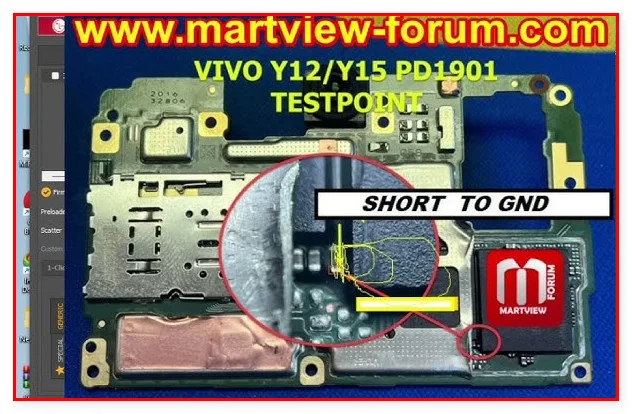
Vivo Y12 Test Point Overview
Test points on the Vivo Y12 are critical contact pads located on the mainboard that allow technicians to access hardware diagnostic signals without requiring full disassembly of complex connector interfaces. These pads provide direct access to voltage rails, ground planes, and CPU/eMMC communication lines. Proper identification and safe use of test points enable rapid troubleshooting of boot failures, FRP lock issues, and dead-device scenarios. The Y12's layout includes standard GSM test pads distributed across the board near the processor and storage IC.

When to Use Test Points
Test points become essential in several diagnostic scenarios: when the device fails to power on or boot (dead-boot condition), when FRP (Factory Reset Protection) lock prevents access and standard unlock methods are unavailable, when software flashing via USB fails due to corrupted bootloader, and when voltage rail integrity requires verification before attempting repair. Test points also allow direct memory reading for firmware extraction and validation without risk to the device's connector pins.
Common Test Point Locations
The Vivo Y12 features standard test pads typically located near the main processor and eMMC storage chip. Key locations include:
- Power supply rails (VCC, VCCQ) — verify stable voltage output during boot
- Ground pads (GND) — essential reference points for all measurements
- Clock and command lines (CLK, CMD) — communicate with storage and processor
- Data lines (DAT0–DAT7) — verify signal integrity during read/write operations
- Reset and test pads — force device into recovery or test mode
Exact pad coordinates and silk-screen labels vary by hardware revision; always consult a high-resolution board schematic or reference photo specific to your device version before probing.
Access and Measurement Procedure
Begin by removing the back cover and locating the mainboard. Use a microscope or magnifying lens to identify test pads near the CPU and eMMC. Connect a regulated multimeter to GND as reference. With the device powered off, probe target pads gently using a fine test needle or pogo pin. Record idle voltage readings. During power-on sequences, monitor voltage stability—typical VCC should remain within ±5% of rated specification. For storage access, use professional hardware tools (UMT, Easy JTAG) that connect to ISP/test pads to read or write firmware directly. Ensure proper grounding of your workstation to prevent ESD damage.
Safety Precautions and Best Practices
Always power off the device before probing any test point. Avoid prolonged contact with live rails—use brief, controlled measurements only. Never short adjacent pads or apply external voltage without explicit instruction. The Vivo Y12 operates at 3.3V logic levels; applying 5V will damage the device. Wear an ESD wrist strap when working on live boards. If uncertain about pad function, do not probe—consult the device schematic or experienced technician first. Improper test point usage voids warranty and risks permanent hardware failure.
Pin / Test Point Reference
| Pin | Description |
|---|---|
| VCC | Power supply rail (typically 3.3V) — Reference for voltage stability checks |
| GND | Ground reference pad — Essential for all measurements; probe GND first |
| CLK | Clock signal for eMMC/processor communication |
| CMD | Command line for storage IC communication |
| DAT0 | Data line 0 for eMMC read/write |
| RST | Reset pad to force device into recovery — Use cautiously; short to GND only under instruction |
Tools required: Digital multimeter (DVM), Pogo pins or fine test needle, Microscope or 10x magnifier, ESD wrist strap, UMT platform, EasyJTAG Plus or equivalent
Supported operations: Voltage rail verification, Dead-boot diagnostics, FRP unlock via direct read, Firmware extraction, Bootloader repair, eMMC signal integrity check
⚠ Safety note: 3.3V logic only—do not apply 5V or higher. Power off device before probing. Avoid shorts between adjacent pads. ESD precautions mandatory. Improper test point use causes permanent hardware damage.

Comments (0)
Be the first to comment.